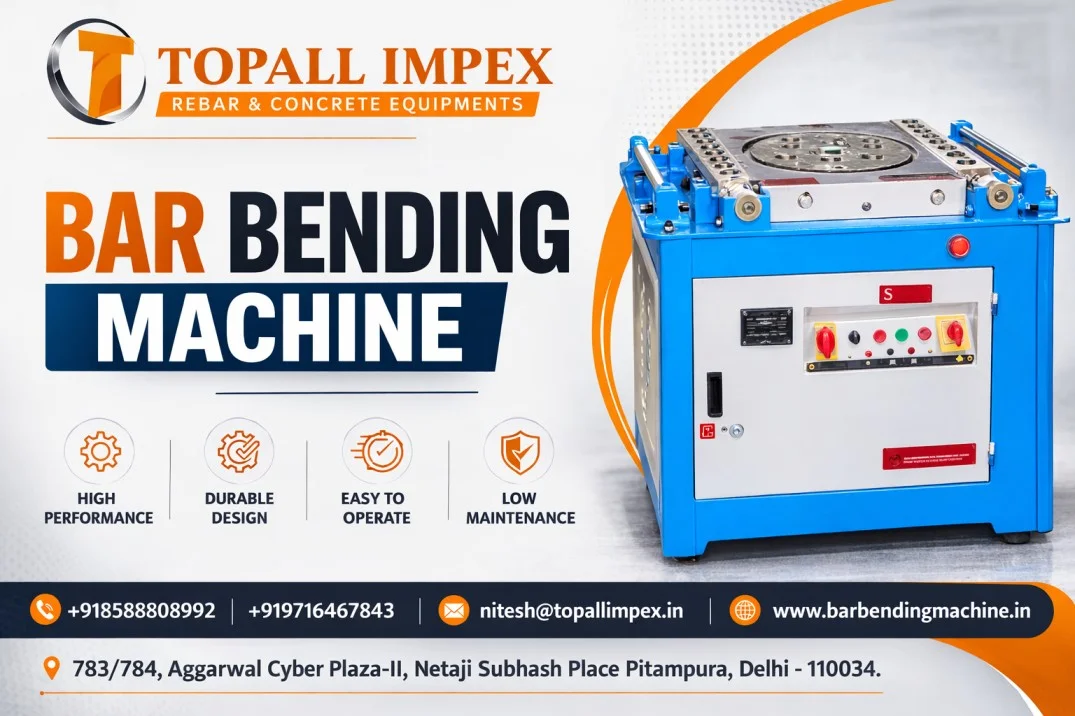
In the rapidly evolving construction industry, efficiency, precision, and productivity are no longer optional—they are essential. One of the most critical processes in construction is steel reinforcement, where bar bending machines play a vital role. However, with technological advancements, businesses now face a key decision: Should you choose a CNC bar bending machine or stick with a conventional one?
This guide will help you understand the differences, advantages, and practical applications of both, enabling you to make an informed investment decision.
What is a CNC Bar Bending Machine?
A CNC (Computer Numerical Control) bar bending machine is an advanced, automated machine that uses pre-programmed software to bend steel bars with high precision. These machines are designed for large-scale operations where accuracy and speed are critical.
Key Features:
- Fully automated operation
- High precision and repeatability
- Programmable bending angles
- Minimal human intervention
- Ideal for mass production
CNC machines are commonly used in infrastructure projects such as highways, bridges, metro systems, and high-rise buildings.
What is a Conventional Bar Bending Machine?
A conventional bar bending machine is a manually operated or semi-automatic machine used for bending steel reinforcement bars. These machines have been widely used in the construction industry for decades.
Key Features:
- Manual or semi-automatic operation
- Lower initial investment
- Suitable for small to medium projects
- Requires skilled labor
- Less complex technology
Conventional machines are typically preferred by small contractors and for projects with limited budgets.
CNC vs Conventional Bar Bending Machines: Key Differences
1. Automation and Technology
CNC machines are fully automated and controlled through software programs, whereas conventional machines rely heavily on manual input.
👉 Result: CNC machines significantly reduce human effort and errors.
2. Accuracy and Precision
Precision is where CNC machines truly excel. They can achieve exact bending angles repeatedly without deviation. Conventional machines, on the other hand, depend on operator skill.
👉 Result: CNC machines ensure consistent quality, especially for complex designs.
3. Production Speed
CNC machines can process a large number of bars in a shorter time due to automation. Conventional machines are slower because they require manual adjustments.
👉 Result: CNC machines are ideal for high-volume production.
4. Labor Requirement
CNC machines require minimal manpower, while conventional machines depend heavily on skilled operators.
👉 Result: CNC machines help reduce long-term labor costs.
5. Initial Investment
CNC machines are more expensive compared to conventional ones, which are budget-friendly.
👉 Result: Conventional machines are suitable for businesses with limited capital.
6. Maintenance and Operation
CNC machines require technical knowledge for operation and maintenance. Conventional machines are simpler and easier to maintain.
👉 Result: Conventional machines are easier for small-scale users.
Advantages of CNC Bar Bending Machines
- ✔ High efficiency and productivity
- ✔ Reduced material wastage
- ✔ Consistent and precise output
- ✔ Lower dependency on labor
- ✔ Ideal for complex and large-scale projects
Advantages of Conventional Bar Bending Machines
- ✔ Affordable initial cost
- ✔ Simple operation
- ✔ Easy maintenance
- ✔ Suitable for small projects
- ✔ No need for advanced technical training
Which One Should You Choose?
The choice between CNC and conventional bar bending machines depends on your business requirements, budget, and project scale.
Choose CNC Machines If:
- You handle large-scale construction projects
- You need high precision and automation
- You want to reduce labor costs in the long run
- You focus on productivity and efficiency
Choose Conventional Machines If:
- You have a limited budget
- Your projects are small or occasional
- You prefer simple machinery
- You have access to skilled labor
Cost vs Value: A Practical Perspective
While CNC machines have a higher upfront cost, they offer better long-term value through:
- Increased productivity
- Reduced labor expenses
- Lower material wastage
In contrast, conventional machines are economical initially but may lead to higher operational costs over time due to labor dependency and lower efficiency.
Future Trends in Bar Bending Technology
The construction industry is steadily moving toward automation. CNC bar bending machines are becoming more popular due to their ability to integrate with digital construction workflows.
Key trends include:
- Smart machines with IoT integration
- Increased use of automation in construction
- Demand for precision engineering
- Growth in infrastructure projects in India
Conclusion
Both CNC and conventional bar bending machines have their place in the construction industry. While conventional machines are reliable and cost-effective for smaller projects, CNC machines represent the future with their automation, precision, and efficiency.
If your goal is to scale your operations, improve productivity, and stay competitive, investing in a CNC bar bending machine is a strategic move. However, for smaller businesses or short-term needs, conventional machines still offer excellent value.